
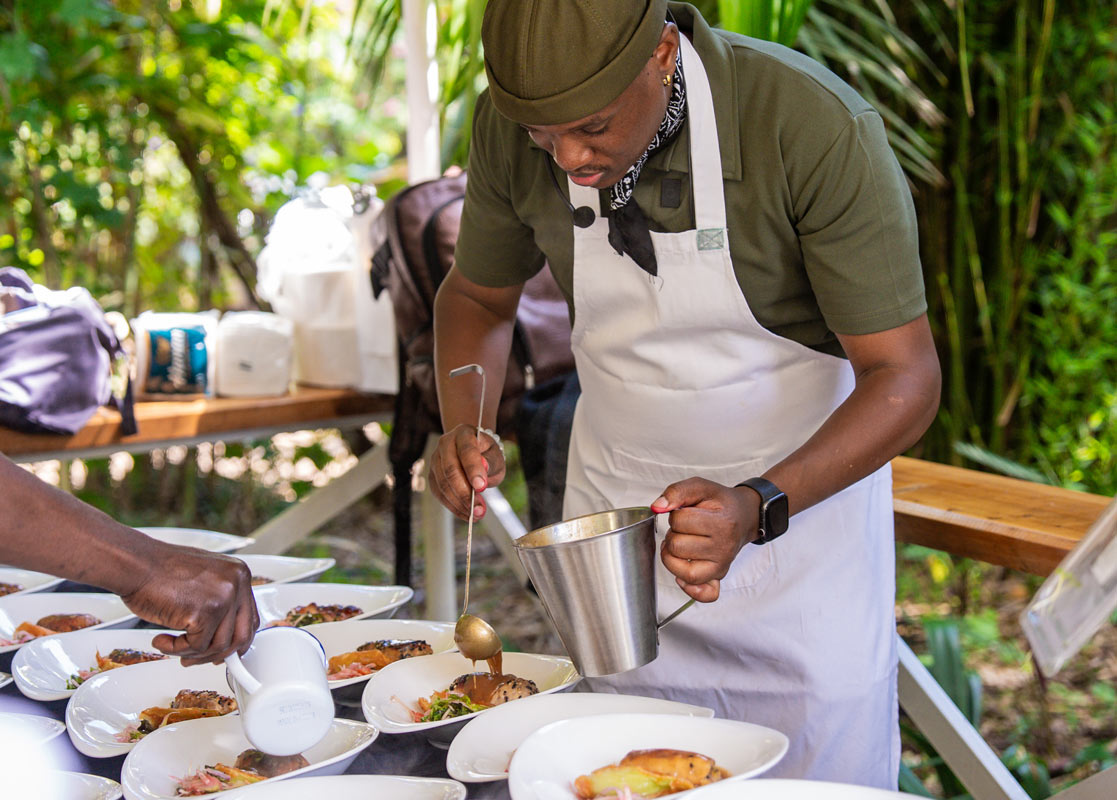
For Kiarie, food is not just sustenance but also storytelling. Each dish is an argument against the idea that African cuisine cannot belong in the fine dining conversation
I sit across from Kim Kiarie as he gently places what looks like a sculpted story in front of me, an egg, but not quite the egg I know. It rests on a textured plate, accompanied by something resembling folded newspaper, only it’s carved from Kisii stone. He watches, not anxiously, but with the quiet curiosity of someone who knows food is a conversation.
“This is our interpretation of mayai ya asubuhi,” he says, smiling.
The egg has been boiled, poached, then cured in soy, miin, and oyster sauce, its surface glowing with a rich, lacquered finish. Around it, layers unfold—black bean purée, garlic cream, a whisper of alfredo made from blended beans. Salmon roe bursts with a saline pop, replacing ordinary salt. Even the edible flowers, he notes, are grown at home.
It is familiar, but also not. Kenyan, but reframed.
Rewriting the Plate
For Kiarie, food is not just sustenance but also storytelling. Each dish is an argument against the idea that African cuisine cannot belong in the fine dining conversation. His approach is deliberate: take what people already know, then elevate it without erasing its identity.
The next course arrives, a reimagined version of chemsha. Slow-cooked lamb, pulled apart after hours in the oven, sits atop a bed of potatoes and Brussels sprouts. The broth it was cooked in has been reduced into a deep, velvety sauce, finished with garlic cream and a hint of ginger.
“It’s about bringing the flavor here,” he explains. “You can’t compete with the original at home but you can reinterpret it.” By the time the grilled red snapper lands, which is served with white beans, fermented vegetables, and a coconut-infused French-style sauce, it becomes clear that Kiarie is doing more than cooking. He is negotiating identity on a plate.
A Chef Shaped by Journey
Kiarie’s culinary philosophy did not emerge overnight. His journey began in Nairobi, where a childhood spent watching his mother cook on Sundays quietly planted the seed. Unlike many chefs of his generation, his passion wasn’t sparked by television or celebrity chefs but was instinctive, almost inherited.
He traces it back to lineage: a great-great-grandfather, Ezra Irongo, and a great-grandfather, Kefa, both cooks in their time. From Nairobi, his path led him to culinary school, then across continents—to Switzerland, France, and later Qatar. Each stop sharpened a different edge of his craft.
In Switzerland, he learned structure on business, systems, discipline. In France, particularly within the demanding ecosystem of Michelin-star kitchens, he discovered reverence for ingredients.
“That’s where I understood food,” he says. “Respecting the product from how it’s grown to how it’s plated.”
France, he notes, didn’t just teach him technique. It taught him restraint.
Qatar, however, offered a different lesson. Despite working in high-level kitchens, the experience exposed the rigid hierarchies of global hospitality. As the only Kenyan in his space, growth felt limited. Eventually, he made a decision that would define his career: to return home.
“I realized if I can do this here, why am I not doing it for myself?”
Building Something Different
Back in Kenya in 2018, Kiarie opened his restaurant, a bold move in a market where fine dining was still finding its footing. At the time, Nairobi’s upscale food scene leaned heavily on European influences. French, Italian, and continental menus dominated, often disconnected from local culinary identity.
Kiarie initially followed suit, drawing from his training abroad. But something shifted around 2021.
“I looked around and realized no one was really telling our story,” he says.
That realization sparked a transformation. His menu began to evolve—rabbit dishes inspired by rural traditions, banana textures rooted in everyday Kenyan meals, even camel appearing as a nod to northern communities. Each plate carried narrative weight.
Food, for him, became a medium of cultural preservation and reinvention.
The African Fine Dining Question
At the heart of Kiarie’s work is a larger question: What does fine dining mean in an African context?
For many, the concept still feels imported with white tablecloths, French terminology, and expensive, often foreign ingredients. There remains a lingering perception, shaped by colonial history, that African food is too rustic, too simple to be “elevated.”
Kiarie disagrees.
“Fine dining is about refinement,” he explains. “It’s about how you treat the ingredient.”
He offers a simple example: githeri, a staple mix of maize and beans. In its traditional form, it is hearty and functional. But in his hands, it becomes something else, softer corn replacing dry maize, butter beans for richer flavor, finished with pomegranate and herbs. The essence remains. The experience transforms.
Even ugali, perhaps the most iconic Kenyan staple, is not off-limits. He reimagines it as croquettes stuffed with sukuma wiki and minced meat, rolled and crisped, yet still unmistakably ugali.
“It’s not about changing who we are,” he says. “It’s about showing what we can be.”
A Continent on the Rise
Kiarie’s vision aligns with a broader shift happening across Africa. From Lagos to Cape Town, chefs are increasingly turning inward drawing from indigenous ingredients, traditional techniques, and local narratives to redefine luxury dining.
In Kenya, the movement is gaining momentum. More fine dining spaces are opening, and diners are becoming more adventurous. There is a growing appetite not just for good food, but for meaningful food.
Kiarie sees this as an opportunity.
“We love things like salmon,” he says. “But it’s expensive, imported. Why not use what we have and elevate it?”
It’s a philosophy that extends beyond the restaurant. From judging international cooking shows to developing nutrient-rich recipes for school feeding programs, his work is rooted in impact as much as innovation.
Story originally by Harriet James @peopledaily (Sunday, April 12, 2026) – original article here